



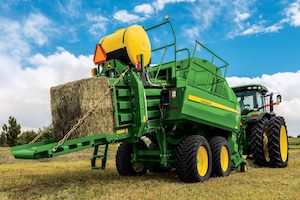
Haymaking is an important agricultural process that helps farmers preserve forage in order to feed their livestock all year round. This process requires five crucial steps, including mowing, tedding, raking, baling, and storing to create either round or square hay bales. This guide will walk you through the hay baling process, the difference between hay equipment like round and square balers, and the most common hay bale sizes and dimensions.
Key Takeaways
- Haymaking involves five crucial steps, including mowing the forage, tedding the hay, raking the windrows, baling the hay, and storing the hay.
- Several pieces of equipment are necessary for baling hay, including mowers, tedders, rakes, balers, and additional attachments.
- The size, shape, and weight of hay bales can vary depending on the type of baler you use, whether that is a round or square baler.
- Round balers help to make cylindrical-shaped bales that are highly efficient for large-scale baling operations.
- Square balers make square-shaped bales that are easy to handle and stack, making them best suited for smaller farms.
- Choosing the correct hay bale size is important because it affects handling efficiency, storage requirements, transportation costs, and feeding management.
What Are the Steps to Make Hay?
Making hay involves a series of steps to create stable hay bales that are easy to store and transport. While the exact details depend on the hay-making equipment you use, the process traditionally follows the same five steps:
1. Mow the forage
2. Ted the hay
3. Rake the windrows
4. Bale the hay
5. Store the hay
1. Mow the Forage
The first step in the haymaking process is mowing the forage. Farmers should monitor weather conditions and target adequate drying time before baling. Depending on crop and conditions, hay may require several days to properly cure. Hay is commonly cut several times in the growing season, with the first cutting occurring in late spring, and additional cuttings over the summer and into the early fall. Hay mowers and mower conditioners are used during this step to cut the crop and prepare it for drying.
2. Ted the Hay
After mowing, a hay tedder is typically used to spread and fluff the forage, allowing more air to circulate to speed up the drying process. Tedding ensures that no excess moisture is present in the hay before baling begins, which can improve bale quality and reduce the risk of mold. To maximize airflow, operators should follow equipment recommendations and adjust travel patterns to improve forage distribution and drying.
3. Rake the Windrows
Once the hay has dried, the next step is to rake the forage into clean and even rows known as windrows that the baler will eventually pick up to make rolls of hay. Creating consistent windrows will help farmers improve the quality of their hay bales and collect hay more efficiently.
4. Bale the Hay
After hay has been raked, a round or square baler will collect the windrows and compress them into round or square-shaped bales depending on a farmer's needs. The type of baler you choose will determine the size, shape, and other dimensions of a finished bale. It is recommended that farmers bale in the early afternoon after the dew has left the ground.
5. Store the Hay
The fifth and final step of the haymaking process is properly storing the hay to protect it from moisture and mold. Whenever possible, hay should be stored indoors, away from sunlight, in a well-ventilated area such as a barn or shed to preserve its quality. It is not recommended that you store hay on concrete or dirt, as moisture can absorb and harm the bale. Instead, bales are traditionally stacked on wooden pallets, gravel, or another raised surface.
What Equipment Do You Need to Bale Hay?
There is a variety of equipment that can be used to bale hay, each designed to serve a specific purpose in the haymaking process. The most common pieces of equipment to bale hay include mowers, tedders, rakes, and balers. Understanding the role of each machine, as well as the size of your operation and the amount of hay that needs to be baled, will help you choose the right haymaking equipment.
Hay Mowers
Hay mowing equipment is used for cutting the forage at the beginning of the haymaking process. Hay mowers come in a variety of shapes and sizes, including smaller lightweight sickle bar mowers and higher-speed disc mowers. Below you can find common types of hay mowers:
- Sickle Bar Mowers: A small, lightweight mower that uses triangular blades for a slower, more traditional cut. They are ideal for small acreage and use little fuel during operation.
- Disc Mowers: A heavier-duty, high-speed mower with free-swinging blades to tackle large fields with greater efficiency.
- Drum Mowers: Durable mowers designed to handle rugged, uneven terrain with ease. Offer reliable cutting and can function well with lower-horsepower tractors
- Mower Conditioners: Cuts and conditions the forage in a single pass to promote faster and more uniform drying.
Hay Tedders
Hay tedders are used to spread and fluff the forage across a field after mowing. They work by using spinning tines to lift and spread the hay, allowing more air to circulate. By improving airflow, hay tedders help to reduce excess moisture and dry the hay more evenly. As a result, they play an important role in preparing the hay for raking and baling.
Hay Rakes
Hay rakes are used to gather the dried forage into consistent windrows before baling begins. Creating uniform windrows helps improve the consistency and quality of the hay bales. There are several different types of hay rakes, and the type you use can influence the shape of your windrow.
- Wheel Rakes: Uses a series of spiked wheels to move the forage into windrows. They are highly productive and are traditionally used on large plots of land.
- Rotary Rakes: Uses a rotor with curved arms to gently gather the forage into windrows. They are often preferred when you want to prioritize the quality of the forage and limit the risk of contamination.
- Parallel Bar Rakes: Uses parallel bars with tines to carry the hay to form a windrow. They are best suited for smaller to medium-sized fields.
- Belt Rakes: Uses rotating belts with tines to make fluffy windrows. These lightweight rakes are more compact in size and are easy to use.
Hay Balers
Hay balers are used to compress the forage into bales in order to securely store them for future use. The two most common types of hay balers are round balers and square balers, which determine the shape and size of the finished bale. Small square balers are commonly used on smaller operations, while both round balers and large square balers are popular on larger commercial hay operations.
- Round Balers: These balers grab and roll the hay into tight cylindrical bales. These bales are more resistant to moisture and are used for larger-scale operations.
- Square Balers: These balers collect and compact the hay into square-shaped bales. Small square bales are easy to handle and stack, making them an ideal choice for smaller farms.
Hay Baling Attachments
When baling hay, certain attachments can enhance the efficiency and ease of the hay baling process. Here are some common hay baling parts and attachments that can be beneficial for hay baling:
- Bale Spears - Used to lift and transport bales with a tractor.
- Bale Accumulators - Used to collect and organize small bales for easier transport.
- Grapples - Used to help operators grab more than one bale at a time.
- Bale Wrappers - Used to wrap bales in plastic to help preserve their quality.
What Is the Difference Between Round Balers and Square Balers?
The biggest difference between square balers and round balers is the type of shape produced when baling hay or other materials. Square balers are used to compact hay into smaller square-shaped bales, while round balers are used to create much larger round bales, used for large-scale hay harvesting.
Round Balers: A round baler is a hay baling system that picks up hay from the ground and feeds it into a bale chamber. From there, the hay is then wrapped in layers with the help of 6 to 8 long rubber belts and is formed into a cylindrical bale.
Square Balers: A square baler is a hay baling system used to compact, compress, and cut hay and other materials into square-shaped bales, making it easy to handle, transport, and store.
How Do Round Balers vs. Square Balers Work?
Round Balers: Round balers collect forage from a windrow and feed it into the bale chamber. Belts are then deployed to begin forming it into a tight, dense core. As more hay enters the chamber, it is compressed and continues to build in size. The baler applies and adjusts pressure to ensure a consistent density throughout the process. Once the bale reaches its desired size, it is wrapped with twine and ejected from the machine.
Square Balers: A square baler works by collecting loose hay and other materials off the ground and feeds it into the bale chamber. From there, a plunger moves back and forth towards the hay and compresses the hay collected into a square shoot. Finally, when the hay is pushed through the square bale chamber, the twine is wrapped and tied around the bale, which helps keep the bale together and maintain its square shape.
What Are the Benefits of Round Balers vs. Square Balers?
Round Balers: Round balers are more resistant to moisture, and they have a longer shelf life. Round bales are often preferred for larger operations because they can reduce labor requirements and offer good weather resistance. By using a round baler, farmers will see bales that are less vulnerable to weather and are easy to unravel for feeding.
Square Balers: Large square balers can produce high volumes of hay efficiently, while small square balers provide manageable bales that are easier to handle and stack due to their uniform shape. Additionally, square bales are preferred as they provide easy feeding for animals that farmers are used to.
What Are the Standard Hay Bale Sizes, Weights, and Dimensions?
As farmers across the country know, haying plays a critical role in keeping production up and running throughout the year. To get the most out of their hay bales, though, producers must first consider what hay bale weights and dimensions are best for their farm, and what hay equipment they’ll need to create them.
Hay bales come in a variety of sizes depending on the baler and scale of operation. For those feeding a small amount of livestock, small, square hay bales are recommended as they can be easily carried by hand. The dimensions of these hay bales vary by how many strings are used to hold them together. As approximately 10-12 square bales make one round bale, square bales are best for small farms in order to reduce waste.
Large, round bales of hay are an ideal choice for farms with a large population of livestock – this is thanks to the capacity to feed multiple cows at once. Hay bales of these dimensions ensure that farmers spend less time and money creating the bale.
To help compare the most common hay bale sizes, dimensions, and weights, refer to the chart below. Actual bale dimensions and weights vary by forage type, moisture content, baler model, and bale density settings.
| Bale Size: | Dimensions: | Weights: |
|---|---|---|
| Small Two-String Square Bale | 14” high x 18” wide x 35” long | 50 - 60 lbs |
| Small Three-String Square Bale | 16” high x 22” wide x 44” long | 75 - 100 lbs |
| Large Square Bale | 36” high x 36” wide x 96” long | 800 - 1500 lbs |
| Small Round Bale | 4 ft diameter x 4-5 ft width | 600 - 800 lbs |
| Large Round Bale | 5-6 ft diameter x 5-6 ft width | 1200 - 2000 lbs |
The dimensions, density, and weight of hay bales have a major impact on nutrient content, value for being bought and sold, cost of feeding livestock, and how easily they can be transported and stored. In other words, if farmers are to get the most out of their time and effort, they should decide which size hay bales are right for them.
Choose the Right Haying Equipment for Your Farm
Choosing the right haying equipment requires an understanding of the full process of how to bale hay. The type of equipment you use and the size can greatly impact long-term farm productivity. Whether you are working with round or square bales, having the right haying equipment is essential for efficient baling.
With an impressive history of haying equipment, John Deere is sure to offer an ideal hay baler to produce the perfect bales for you. For more information regarding John Deere hay equipment, contact your local John Deere dealer.
Related Hay Equipment
Explore used hay equipment for each stage of the haymaking process:
How to Bale Hay FAQs
How long should hay sit before baling?
The ideal drying time for hay before baling can vary depending on several factors such as weather conditions, the type of hay being harvested, and humidity levels. However, as a general rule of thumb, hay should typically sit in the field for about 3-5 days before baling. To determine if your hay is ready for baling, it's essential to monitor and measure its moisture content. It’s recommended that moisture content is generally around 15% for small square bales, 18% for large square bales, and 14% for round bales.
What happens if hay gets rained on before baling?
If hay gets rained on before baling, there can be a series of potential consequences, including moisture retention, heat generation, color and aroma changes, difficulty baling, and degraded nutrition quality.
What happens if hay is baled too dry?
If baled hay is too dry, it can increase bitterness, fire risk, dust, and leaf shatter, as well as decrease palatability and nutrition quality.
Are all hay bales the same size?
No, hay bales come in a variety of sizes. The most common sizes of hay bales include 14" high x 18" wide x 35" long for square bales and 4 feet wide by 5 feet in diameter for round bales.
How are hay bales stored and transported?
Depending on the size and type of hay bale, as well as the amount of hay that needs to be stored, will dictate the way it is stored and transported. That said, most hay bales are stored in hay barns or hay sheds, and are transported using trucks or trailers.
What happens if round bales get wet?
If a round bale of hay gets wet, it can develop mold and rot, which can make it unfit for animal feed. The moisture can also increase the risk of combustion, as the hay can self-ignite.
What size tractor do you need to pull a round baler?
Horsepower requirements vary by baler size and model. Operators should consult manufacturer specifications to determine the tractor requirements for their equipment.
How much horsepower do you need to run a small square baler?
For many small square balers, you’ll need at least 25-35 horsepower on your tractor's PTO.
What crops can a square baler harvest?
A square baler is most commonly used to collect hay; however, cotton, straw, flax, and silage are some other crops that can be harvested using a square baler.